


Music as a Map: Cultural Journeys in Sound
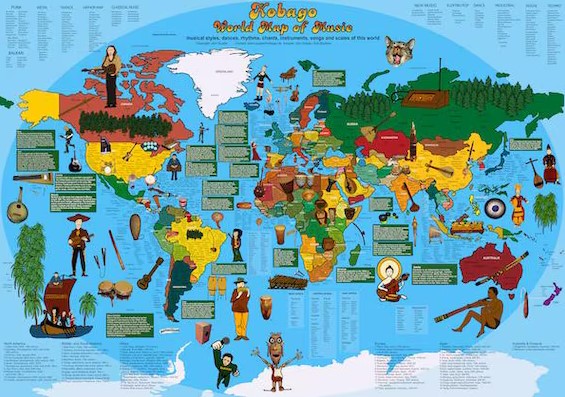
Source:https://i.etsystatic.com
The air in the cramped, dimly lit basement in Seville’s Santa Cruz quarter was thick with the scent of aged sherry and tobacco. I watched a flamenco singer close his eyes, his face contorting in pure agony as a raw, gravelly lament tore from his throat. The acoustic guitar followed him, rapid-firing syncopated rhythms that felt like a localized earthquake. I didn’t understand a word of the Andalusian dialect, but the hairs on my arms stood up instantly; I was listening to the centuries-old pain, migration, and survival of the Romani people.
If your travel itineraries are built solely around tick-box monuments and Instagram-famous viewpoints, you are essentially viewing the world with the sound muted. A staggering number of travelers return from foreign destinations feeling they only scratched the surface, never truly connecting with the locals.
Over my past ten years as a global travel writer, I’ve discovered a profound truth: the quickest way to bypass the tourist bubble is to follow the soundscape. Designing your travels around cultural music journeys transforms a standard vacation into a multi-sensory masterclass in human history.
The Acoustic Landscape: Why Sound is the Ultimate Heritage Blueprint
To understand a destination’s sonic identity, you have to think like an ethnomusicologist. Music is not just entertainment; it is an oral archive.
Think of a region’s traditional rhythm like an ecosystem’s geological timeline. Just as layers of sediment reveal past volcanic eruptions and climate shifts, traditional song structures reveal trade routes, forced migrations, and cultural blendings. For instance, you cannot understand the complex polyrhythms of the Caribbean without mapping the dark history of the transatlantic slave trade.
When you embark on cultural music journeys, you are learning to read these sonic footprints. It is an exploration format that decodes a community’s soul through their instruments, scales, and communal dances.
Iconic Sonic Routes for the Intrepid Audio Traveler
While every corner of the globe hums with its own distinct frequency, a few regions offer deep, highly accessible entry points into traditional sonic heritage. These destinations are perfect for travelers ready to graduate from casual listeners to cultural explorers.
1. The Delta Blues and Jazz Highway, USA
Tracing the Mississippi River from New Orleans up to Chicago is the ultimate pilgrimage for anyone wanting to understand modern popular music.
-
The Blueprint: New Orleans is the birthplace of jazz, an explosive syncopated gumbo of African drum rhythms, European marching band horns, and Caribbean folk pulses. Head north into the Mississippi Delta, and the sound strips down to acoustic slide guitars and vocal call-and-response patterns.
-
My Insider Insight: Skip the hyper-commercialized, neon-soaked clubs on Bourbon Street. If you want the real, unvarnished history, head to the smaller juke joints in Clarksdale, Mississippi, or the local brass band second-lines in Tremé. That is where the music still serves its original purpose: communal healing.
2. The Gamlan Traditions of Bali and Java, Indonesia
The ceremonial bronze orchestras of Indonesia offer an entirely different acoustic philosophy, radically contrasting with Western musical systems.
-
The Experience: Sitting in an open-air pavilion (pendopo) while dozens of musicians strike bronze metallophones, gongs, and drums in intricate, interlocking patterns.
-
The Technical Concept: Gamelan music uses unique tuning systems like slendro (a five-tone scale) and pelog (a seven-tone scale). The hypnotic, cyclic structure isn’t designed to tell a linear story; it is mathematically constructed to mirror the Hindu-Buddhist concepts of cosmic time and spiritual balance.
3. The Gnawa Spiritual Rhythms of Essaouira, Morocco
On the Atlantic coast of Morocco, the ancient spiritual music of the Gnawa people provides a deeply hypnotic sonic immersion.
-
The Narrative: Blending sub-Saharan African Islamic spiritual songs and rhythms with Arabic melodies, Gnawa music relies on the heavy clanging of iron castanets (qraqeb) and the deep resonance of the three-stringed lute (guembri).
-
The Live Context: While the massive Gnaoua World Music Festival draws crowds every summer, the most profound way to experience it is through small communal gatherings known as lila, where the repetitive acoustic patterns are used to induce spiritual trances.
The Terminology of Sound: Speaking the Language of Music Travel
Before you pack your headphones and head out on your first audio-centric expedition, let’s break down the LSI keywords and technical terms you will encounter:
| Technical Term | What It Actually Means | Why It Matters to Your Travels |
| Ethnomusicology | The study of music within its cultural, social, and global contexts. | The foundational framework for understanding music as a living history. |
| Syncopation | A musical rhythm that stresses the weak or unexpected beats. | The rhythmic secret behind the infectious energy of jazz, reggae, and samba. |
| Oral Tradition | Cultural material, history, and art transmitted orally from one generation to another. | Explains why many ancient folk songs are never written down on sheet music. |
| Sonic Heritage | The preservation of intangible cultural assets through historical soundscapes and instruments. | Helps travelers appreciate endangered musical styles protected by UNESCO. |
💡 Pro-Tip: The “Concert Hall” Blunder
Many intermediate travelers think booking an expensive ticket at a state-sanctioned national concert hall is the best way to experience cultural music journeys. Often, it is the exact opposite. Formal stages tend to sanitize folk music for mass consumption. Look instead for community workshops, independent instrument makers, street festivals, or religious ceremonies where the music exists in its natural, functional habitat.
The Commercialization Trap
As music tourism grows, be wary of experiences labeled “Traditional Folk Show + Dinner Buffet.” Nine times out of ten, these are highly choreographed, Disneyfied spectacles designed for cruise ship crowds.
The performances are often stripped of their complex historical contexts, political resistance, or spiritual weight just to make them palatable for tourists. Look for independent local guides or community-led cultural initiatives that focus on education and preserve the raw, unedited roots of their sonic art.
How to Prepare for an Audio-Centric Cultural Journey
To maximize your appreciation for the world’s diverse musical ecosystems, follow this practical field checklist:
-
Study the History Before You Fly: Spend an hour researching the social history of your destination. Understanding the political struggles or religious migrations behind a genre completely changes how you perceive its emotional weight.
-
Invest in High-Quality Field Recording Gear: You don’t need clunky professional setups. A compact, high-quality directional microphone that plugs into your smartphone allows you to capture pristine audio clips of street musicians, rainforest soundscapes, or market chants for your travel journals.
-
Respect the Sacred Silence: In many global traditions, particularly indigenous ceremonies or monastic chanting, music is a prayer, not a performance. Always ask permission before recording, and put your camera away if it disrupts the spiritual environment.
Tuning In to the World
When we travel with our ears open, the world changes shape. Borders fade, and the shared human experience becomes beautifully obvious. Whether it’s the hypnotic loop of a Moroccan lute or the sharp, syncopated blast of a New Orleans horn, music maps the world in ways maps never could. It tells the true story of who we are, where we’ve been, and how we survived.
Over to You! What is the most mesmerizing local musical performance you’ve ever stumbled upon while exploring a new country? Are there any specific cultural music journeys currently sitting at the top of your travel bucket list? Drop your stories in the comments below—let’s talk music!