


Sacred Ruins: Hidden Jungle Temples to Explore
Source:https://ichef.bbci.co.uk
You hack through a wall of wet foliage, wipe sweat from your eyes, and suddenly find yourself face-to-face with a 1,000-year-old carved stone face wrapped tightly in massive strangler fig roots. There are no tour buses here, no megaphones, and no velvet ropes keeping you 20 feet back. Just the raw sound of the forest, the smell of damp moss, and centuries of forgotten history sitting quietly in the shade.
After spending over a decade trekking through the dense rain forests of Southeast Asia and Mesoamerica, I have seen far too many travelers fall into the “tourist trap” routine. They queue for hours at main archaeological hubs, snapping photos over the shoulders of hundreds of other visitors, completely missing the true magic of exploration. The most profound encounters with ancient civilizations do not happen at the main entrance of heavily restored complexes—they happen deep off the beaten path, where hidden jungle temples remain partially reclaimed by nature.
Whether you are a curious beginner taking your first step beyond basic resort excursions or an intermediate adventurer ready to cross overland borders, this deep-dive guide breaks down how to discover, access, and respect the world’s most mesmerizing remote sanctuaries.
The Magnetism of Hidden Jungle Temples: Beyond the Tourist Hubs
Visiting a fully restored, manicured heritage site vs. finding an overgrown ruin is like watching a zoo animal versus spotting wildlife in its natural habitat. Restored sites offer convenience, but raw, un-manicured ruins preserve the romance of discovery and the sheer power of ecological succession.
Think of deep forest archaeological sites like time capsules locked inside a biological vault. The rainforest canopy creates a humid microclimate that acts as a natural shelter, preserving intricate bas-reliefs while simultaneously trying to pry the masonry apart with massive root systems.
+-----------------------------------------------------------------------------------+
|                     ANATOMY OF A JUNGLE ARCHAEOLOGICAL SITE                       |
+-----------------------------------------------------------------------------------+
|  [ Forest Canopy ]    ----> Humidity control & sun protection                     |
|  [ Strangler Roots ]  ----> Structural tension & natural masonry locking          |
|  [ Lichen & Moss ]    ----> Surface degradation & organic camouflage              |
|  [ Sub-Soil Layers ]  ----> Unexcavated foundations & undiscovered plazas         |
+-----------------------------------------------------------------------------------+
When you target hidden jungle temples, you are engaging with three key elements:
-
Organic Preservation: Understanding how ancient builders adapted mortarless stone joinery (ashlar masonry) to survive tropical rainfall and root intrusion.
-
Low-Impact Archaeology: Experiencing sites that remain intentionally unrestored to protect structural integrity and preserve the natural ecosystem.
-
Authentic Atmosphere: Exploring ruins without heavy crowds, commercial vendors, or artificial barriers.
Premier Global Destinations for Jungle Temple Exploration
While iconic sites like Angkor Wat or Chichén Itzá draw millions, sprawling jungle networks across Asia and Central America hold lesser-known ruins that offer unmatched adventure.
| Region & Destination | Ancient Culture | Signature Feature | Access Difficulty | Ideal Season |
| Beng Mealea & Koh Ker (Cambodia) | Khmer Empire | Overgrown Moats & Tree-Strangled Towers | Moderate (Dirt roads) | Nov – Feb (Dry) |
| Yaxchilán & Bonampak (Mexico) | Maya Civilization | Riverboat Access & Intact Murals | Intermediate | Nov – April |
| My Son Sanctuary (Deep Zones, Vietnam) | Champa Kingdom | Brick Towers surrounded by Dense Valley | Easy to Moderate | Dec – March |
| Tikal (Peripheral Structures, Guatemala) | Maya Civilization | Soaring Pyramids Peeking Over Canopy | Moderate | Nov – April |
| Gunung Kawi & Prasat Mengening (Bali) | Ancient Balinese | Rock-Cut Shrines along River Canyons | Easy | April – October |
1. Cambodia’s Forest Complex: Beng Mealea & Banteay Chhmar
Located roughly 60 kilometers east of the main Angkor Archaeological Park, Beng Mealea was built in the same architectural style as Angkor Wat, but left largely untamed.
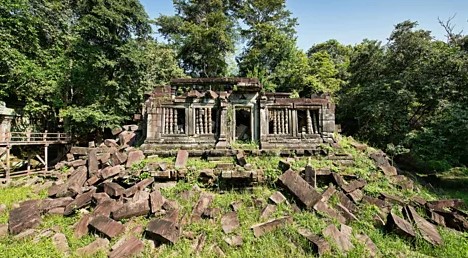
Here, you navigate collapsed stone galleries via elevated wooden walkways while massive lichen-covered blocks lie piled below like oversized dominoes. Further north sits Banteay Chhmar, a sprawling temple complex where carved face-towers peek out from behind thick jungle vines with barely a visitor in sight.
2. The Usumacinta River Basin: Yaxchilán (Mexico)
Deep in the Lacandon Jungle along the border of Mexico and Guatemala lies Yaxchilán, an ancient Maya city accessible only by traveling down the Usumacinta River on a motorized wooden longboat (lancha).
Arriving at sunrise, you step off the boat into mist-shrouded ruins where howler monkeys roar from the canopy above and carved limestone lintels remain fully intact over dark stone doorways.
Logistics Masterclass: How to Access Deep Jungle Ruins
Reaching remote archaeological zones requires more than just calling a rideshare app. You need a structured approach to transport, local regulations, and trail navigation.
                     /---> Arrange Local Specialized Transport (4WD / Riverboat)
                    /----> Verify Park Entrance Permits & Native Village Fees
LOGISTICAL STEPS -------> Download Offline Topographic & Satellite Maps
                    \----> Secure Licensed Native Trackers / Guides
                     \---> Check Micro-Climate & Rain Patterns
1. Master the Multi-Modal Transport Chain
Reaching remote sites often requires combining several modes of transit. For example, a trip to deep Maya or Khmer sites might start with an early morning van ride, transition to a four-wheel-drive dirt path, and finish with a 45-minute riverboat transit or foot trek. Factor buffer time into your itinerary for unexpected vehicle breakdowns or river level changes.
2. Hire Local Community Trackers
In isolated jungle reserves, hiring a guide from the nearest local village is crucial. Native trackers know which stone blocks are unstable, how to spot well-camouflaged pit vipers, and how to navigate obscure trails where GPS signals drop out completely.
Gear Up: Essential Kit for Jungle Explorations
Exploring humid, overgrown ruins demands gear that balances moisture management, insect defense, and structural foot support over slippery, lichen-covered stone.
+-----------------------------------------------------------------------------------+
|                        RUIN EXPLORATION GEAR CHECKLIST                            |
+-----------------------------------------------------------------------------------+
|  [ Gear Item ]       [ Optimal Specs ]           [ Strategic Function ]           |
|  Trail Footwear      Aggressive Lugged Runners   Grip on wet, mossy limestone     |
|  Headlamp            200+ Lumens + Red Light     Illuminating dark stone chambers |
|  Apparel             Ripstop Nylon Pants/Shirt   Protection against thorns/vectors|
|  Daypack Dry-Liner   IPX8 Dry Bag                Protecting camera gear from rain |
+-----------------------------------------------------------------------------------+
Essential Packing Rules
-
High-Lumen Headlamp: Ancient stone temples feature dark inner sanctuaries, corbelled archways, and underground passages where natural light cannot reach. Carry a compact, rechargeable headlamp so your hands remain free to balance on uneven steps.
-
Sticky-Rubber Footwear: Decades of moss and humidity make ancient stone polished and slick. Choose footwear with sticky rubber outsoles (like Vibram Megagrip) rather than smooth-soled lifestyle sneakers.
-
Insect Repellent & Long Layers: Mosquitoes and sandflies thrive around damp stone ruins and ancient moats. Wear lightweight, permethrin-treated long-sleeve shirts and pants to avoid bites without overheating.
Expert Advice: Pro Tips & Hidden Warnings
Pro Tip: The “Shadow Hour” Photography Advantage
To capture the true, ethereal mood of hidden jungle temples, aim to arrive at the site either right as the gates open at dawn or two hours before sunset. Early morning moisture creates sunbeams (god rays) cutting through the dense jungle canopy, while afternoon light casts long, dramatic shadows across relief carvings, bringing flat stone details to life.
The “Unstable Masonry” Trap
Ancient mortarless stone structures held together by gravity and roots can shift without warning. Never climb on crumbling walls, step on dry-stacked lintels, or lean against free-standing pillars just to get a unique camera angle. A loose 50-pound stone block can shift underfoot, leading to severe injury miles away from emergency medical assistance.
Respecting the Sacred: Etiquette for Ancient Ruins
It is easy to view overgrown ruins as a giant adventure playground, but you must remember that many of these sites remain active places of worship for indigenous descendants.
                         HERITAGE CODE OF CONDUCT

 [YES] Treat active altars, incense burners, and statues with reverence
 [YES] Pack out all trash and leave zero trace of your visit
 [YES] Stay on designated pathways and wooden boardwalks
 [NO]  Touch, rub, or lean against delicate wall carvings
 [NO]  Take stone fragments, pottery sherds, or organic souvenirs
-
Treat Active Altars with Respect: In many Central American and Southeast Asian jungle ruins, local villagers still leave fresh flowers, incense, or food offerings at ancient shrines. Avoid touching or stepping near these sacred spaces.
-
Leave Everything in Place: Never collect pottery sherds, carved stone fragments, or ancient bricks as souvenirs. Removing artifacts destroys the archaeological context and violates international heritage protection laws.
-
Practice Zero-Impact Exploration: Avoid touching carved bas-reliefs. The natural oils and acids from human skin break down soft limestone and sandstone over time, accelerating erosion on centuries-old artwork.
Summary & Your Next Step
Exploring hidden jungle temples offers an unforgettable mix of raw nature, ancient human engineering, and true adventure. By choosing lesser-known destinations, preparing the right gear, and respecting both the environment and local traditions, you step beyond ordinary sightseeing and into the shoes of a true explorer.
Have you ever explored an ancient temple hidden deep in the jungle, or are you currently planning your very first heritage trek abroad? Which site is sitting at the absolute top of your dream itinerary? Share your thoughts, trail questions, or favorite ruin stories in the comments below—I read and reply to every single one!