


Above the Trees: Luxury Treehouse Escapes in Nature
Source:https://media.glampinghub.com
The floor beneath my feet hummed with a subtle, rhythmic vibration—not the mechanical thrum of an HVAC system, but the literal breathing of a century-old Banyan tree. I was twenty feet above the jungle floor in Bali, nursing a cup of local coffee as a troop of macaques used my “balcony” as a high-speed highway. At that moment, the $500-a-night price tag felt like a steal. While traditional luxury hotels fight to keep nature out with glass and concrete, luxury treehouse escapes invite the wilderness in, transforming a childhood dream into a sophisticated sanctuary.
In my decade of traversing the globe, I’ve seen the “Glamping” trend evolve from simple tents to architectural marvels suspended in the canopy. Yet, for many travelers, the idea of a treehouse still conjures images of splinters, mosquitoes, and questionable structural integrity. I’m here to tell you that the reality of modern arbor-architecture is far more “Ritz-Carlton” than “Swiss Family Robinson.”
The Engineering of a Canopy Sanctuary
To the uninitiated, a treehouse is a wooden box nailed to a trunk. To a specialized architect, it is a masterclass in dynamic structural engineering. Unlike a house on the ground, a treehouse must account for the oscillating movement of its host.
Think of a luxury treehouse like a moored ship. Just as a ship must sway with the waves to avoid breaking apart, a high-end treehouse is often mounted on “GLZ” (Garnier Limb Z-brackets) or heavy-duty suspension cables that allow the tree to grow and move in the wind without compromising the guest’s safety. When you feel that slight sway during a storm, it’s not a flaw—it’s the building’s way of “dancing” with the tree.
Why Choose Luxury Treehouse Escapes Over a Five-Star Resort?
For the elite traveler, the appeal lies in the Total Sensory Immersive Experience. In a standard hotel, you are an observer of the view; in a treehouse, you are the view.
-
Acoustic Isolation: Being elevated naturally distances you from the “ground noise” of leaf blowers, vehicles, and other guests.
-
Biodiversity Access: Many bird species and primates are strictly arboreal. Staying in the canopy puts you at eye level with wildlife that ground-dwellers only see through binoculars.
-
Bio-Architecture: Most luxury treehouse escapes utilize sustainable materials like reclaimed teak, bamboo, and cork, which have a lower thermal mass, keeping the rooms naturally cooler than concrete structures.
Top Global Destinations for Elevated Living
If you’re ready to trade the elevator for a winding spiral staircase, these three regions are currently leading the world in luxury arbor-tourism.
1. Scandinavia: The Nordic Minimalism
Sweden’s Treehotel is the gold standard for technical innovation. From the “Mirrorcube” (which is coated in infrared film invisible to humans but visible to birds to prevent collisions) to the “UFO,” these are tech-heavy pods designed for extreme cold.
-
The Insight: Staying here in winter taught me about radiant floor heating in sub-zero canopy environments. It’s a surreal feeling to be toasty warm while looking out at a frozen pine forest from twenty feet up.
2. Southeast Asia: The Bamboo Palaces
In Bali and Thailand, “treehouses” are often sprawling, multi-story bamboo cathedrals.
-
Technical Detail: These structures often use borax-treated bamboo, which makes the organic material as durable as steel and resistant to the tropical humidity that usually rots wood in years.
3. The Pacific Northwest, USA: The Cedar Sanctuaries
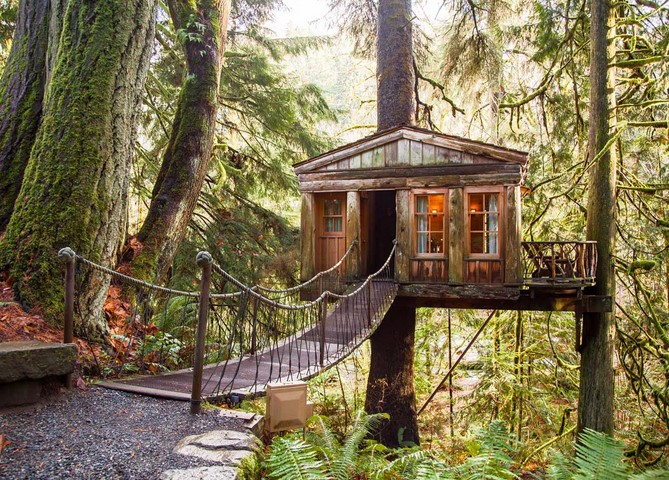
For those who love the scent of pine and the roar of a wood-burning stove, the forests of Washington and Oregon offer heavy-timber escapes built into massive Douglas Firs.
Expert Advice: Navigating the Technical Realities
Even at the highest luxury levels, staying in a treehouse requires a bit of “Arbor-Etiquette” and technical awareness.
Tips Pro: The “Light Hygiene” Rule
Insects are attracted to blue-spectrum light. Most high-end treehouses use amber-tinted LED lighting to minimize the attraction of nocturnal “visitors.” When you’re in your room, try to keep the lights dim or use the “warm” settings to keep the mosquito count at zero.
Beware of “Tree-Wash” Marketing. Some resorts claim to offer treehouses but actually build concrete towers with wood siding near trees. A true luxury treehouse escape should be integrated into the tree’s structure. If the building doesn’t sway slightly in a high wind, it’s probably just a regular house on stilts.
Scannable Checklist for the Elevated Traveler
Before you book your flight, consider these technical factors to ensure your escape is as seamless as possible:
-
Payload Weight: Most treehouses have strict weight limits for luggage. Leave the heavy “checked-in” trunks at home; a 40L carry-on is the sweet spot for navigating the stairs and suspension bridges.
-
Humidity Control: In tropical regions, look for treehouses that offer dehumidification systems rather than just AC. This prevents your clothes from feeling damp in the morning.
-
Connectivity: High-altitude foliage can act as a natural Faraday cage. If you need to work, ensure the property offers Starlink or point-to-point Wi-Fi that can penetrate the canopy.
-
Accessibility: If you have knee issues, check the “Access Method.” Some use electric lifts, while others require a 50-step climb.
The Sustainable Impact of Living Above the Ground
One of the most beautiful aspects of luxury treehouse escapes is their Low Environmental Footprint. Because the building is elevated, the soil beneath remains uncompacted, allowing the root systems and local flora to thrive. Many of these projects are “non-invasive,” meaning if the treehouse were removed tomorrow, the forest would reclaim the space in months.
By choosing these escapes, you are funding the preservation of old-growth forests. Landowners are incentivized to keep ancient trees standing because they are more valuable as “luxury hosts” than as timber.
Conclusion: The Ultimate Perspective Shift
There is something ancient and primal about sleeping in the trees. It recalibrates your circadian rhythm and reminds you that we are, at our core, part of the ecosystem. Luxury treehouse escapes offer the perfect marriage of that raw, visceral connection and the refined comforts of a modern lifestyle.
You aren’t just booking a room; you’re booking a seat at nature’s most exclusive theater.
If you could wake up tomorrow in a glass cube in the Swedish pines or a bamboo palace in the jungles of Bali, which one would you choose? Have you ever stayed somewhere that felt like it was “breathing” with you? Let me know in the comments below!